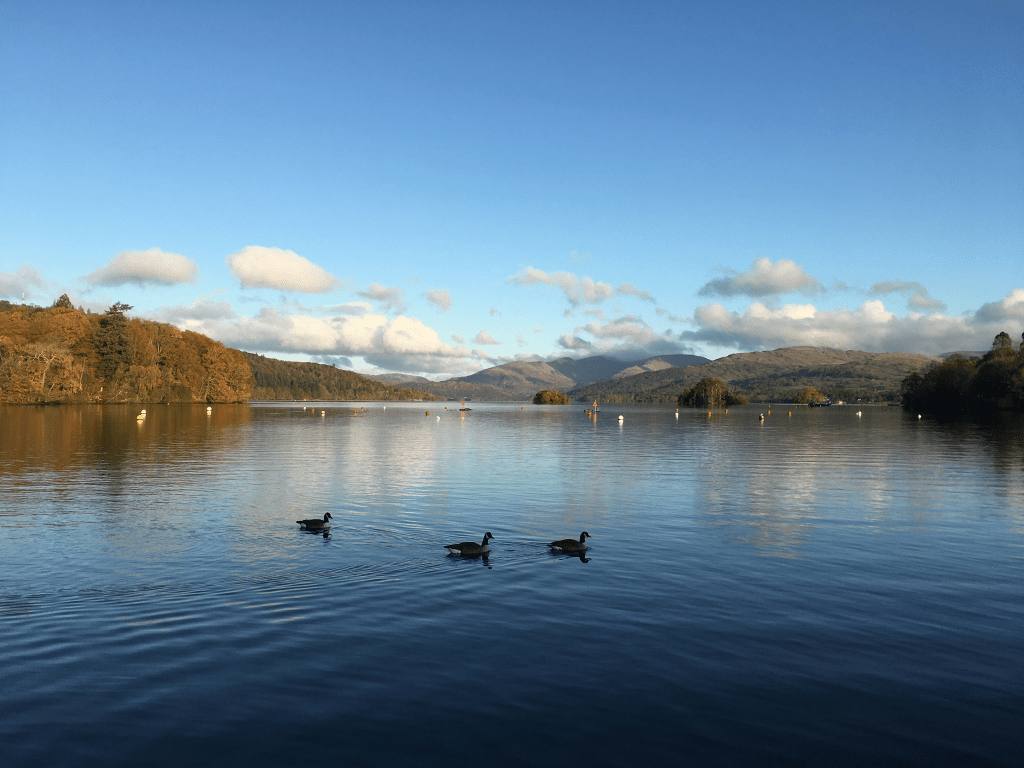
I am lucky enough to live 5 minutes from Windermere, England’s largest lake.
Windermere was once a fishing lake. The main catch was Arctic Char – a delicacy often served ‘potted’. Then in the 19th century the railway arrived and with it an upsurge in visitors, who wanted to enjoy the clear air and clean water of England’s largest lake. Many took pleasure ‘cruises’, and the Victorian business owners who built large second homes adjacent to shore’ commissioned steam launches to ferry themselves and their guests around the 11 mile long lake.
More recently visitors have found new ways to enjoy the lake. Kayaking, Paddle Boarding and Open water swimming have all grown in popularity. The Great North Swim, based at the Lake District National Park Visitor centre at Brockhole, is one of the UK’s biggest swim events. Across 3 days, there are events from 250m to 10km, with thousands of people participating. What could be better than a wild swim, with plenty of lifeguards in England’s biggest lake?
But thanks to the water industry, all is not well in England’s biggest lake. According Matt Staniek, zoologist, conservationist and local resident, Windermere “is on the cusp of ecological and biological destruction…….due to the nutrient phosphorus being dumped into the catchment in unsustainable quantities. The most notable phosphorus input… is sewage”. Proof of the problem is the increasing number of algal blooms seen on the lake, particularly last summer.
This is important as Windermere is important for a host of reasons. It is the centrepiece of the Lake District National Park and is one if the easiest parts to reach. So unsurprisingly it receives the greatest number of visitors. Hundreds of hotels and guesthouses, restaurants, pubs, cafes and leisure businesses, thousands of holiday lets, and the all-important Lake Cruises all rely on those visitors. All these businesses need Windermere to remain clean, for practical and reputational reasons.
So why is raw sewage getting into the lake?
I could spend another 5000 words explaining the link. But the short answer is a business model that puts shareholder income as the only concern of a business. Whatever the consequences.
When water companies were privatised, we were told that it would allow them to be able to invest in the much-needed infrastructure, which would protect the environment and local people. It is clear, that in every region of the UK, this has not happened.
It is simply cheaper for a water company not to invest in adequate sewage treatment facilities. This maximises profit and dividend for shareholders. And if you look at the ownership of UK water companies, the vast majority are owned by overseas corporations, so the more sewage entering UK water means more profit for American, Australian, Middle Eastern and Chinese investors.
In the case of Windermere, the lack of investment risks undermining the economic well-being of tens of thousands of people, and the actual health of wild swimmers, kayakers and Paddle Boarders, simply to reward shareholders.
A business has many stakeholders, shareholders are just one of them. By focussing just on shareholders, that business is essentially expecting the other stakeholders – customers, employees, the local community, suppliers, users of the local environment – to swallow, and pay for the negative consequences. Literally, in the case of wild swimmers.
So where do the British public sit on this?
Well, based on a survey for B Lab UK, 76% believe “capitalism isn’t working well or is harmful to the UK economy”, and as a result 72% of the UK population believe “that businesses should have a legal responsibility to the planet and people alongside maximising profits”. That’s the triple bottom line of people, planet, and profit.
What is interesting is other research, that I shall cover in another post, shows that businesses that think about the long term implications of their actions, that commit to delivering for all stakeholders, that consider people and planet in addition to profit, are more successful over time
Yet UK water companies follow a model that pre-dates the Victorian era of reform, a model that damages the environment, and demands everyone else pay for clearing it up. This is not responsible capitalism. And it is not sustainable.
In most other sectors and industries there are reasons to be optimistic. We now have over 1000 B-Corporations in the UK. I have been privileged to help companies on their B Corp journey. And beyond B Corporations there are thousands of other businesses are making positive steps to be better, with less environmental impact, with a diverse workforce, with people-focussed HR strategies. These changes will ensure a positive future.
But in the case of water companies, and the monopolies they hold, it looks like it will take ‘responsible’ politicians and the proper enforcement of regulation to change them.
I have participated in two Great North Swims, but until proper enforcement of water companies happens, I doubt I will dive into another.
#mattstaniek #bcorpuk
 Bthe
Bthe 